
You roll out of bed, your back feels tight, your knees click a little, and the idea of touching your toes seems like a stretch too far (pun intended). That's completely normal. Most bodies wake up stiffer than they went to sleep, and a few minutes of movement can make the difference between shuffling to the kitchen and walking there like you mean it.
We put together this 10-minute morning routine because we wanted something realistic, not a 45-minute yoga flow nobody has time for before work. It's built around the joints and muscles that tend to complain most after a night in bed: your spine, hips, hamstrings, and shoulders. Grab a glass of water, give yourself a little floor space, and let's get into it.
Why mornings feel stiffer than evenings
While you sleep, your body isn't moving much for six to nine hours straight. Muscles and connective tissue lose some of their fluid content overnight, a bit like a sponge that's been sitting still. This is part of why your spine is measurably shorter in the morning than at night, by roughly a centimeter in some studies, due to the discs between your vertebrae settling back into shape after a day of gravity compressing them.
Joint fluid, called synovial fluid, also moves less during sleep. It's the natural lubricant that helps your knees, hips, and shoulders glide smoothly, and it circulates best when you're active. After hours of stillness, that fluid hasn't been "stirred up" yet, which is part of why your first few steps out of bed can feel creaky.
There's also a hormonal piece. daily balance, which has some anti-inflammatory effects, is typically higher right after waking and dips later in the day. For people with joint conditions like joint mobility, this shift can mean mornings feel noticeably stiffer than afternoons or evenings. If stiffness lasts more than 30 to 60 minutes every single morning, it's worth mentioning to a doctor rather than just stretching through it.
What a 10-minute routine should include
A good morning routine doesn't need to be complicated, but it should hit a few key areas. We like to think of it in three parts: gentle movement to wake up the joints, stretches for the muscles that get tightest overnight, and something for your breathing, since slow breathing helps your nervous system shift out of "sleep mode."
Here's what we aim to cover in those 10 minutes:
- Spine mobility: gentle flexion, extension, and rotation to counter the stiffness from lying still.
- Hip and hamstring stretches: these muscles shorten over the night and affect how you walk and bend for the rest of the day.
- Shoulder and neck movement: especially important if you sleep on your side or stomach.
- Ankle and calf mobility: often skipped, but it matters for balance and for anyone who'll be walking or standing most of the day.
- A few slow breaths: three to five deep breaths at the start or end can help you feel less rushed.
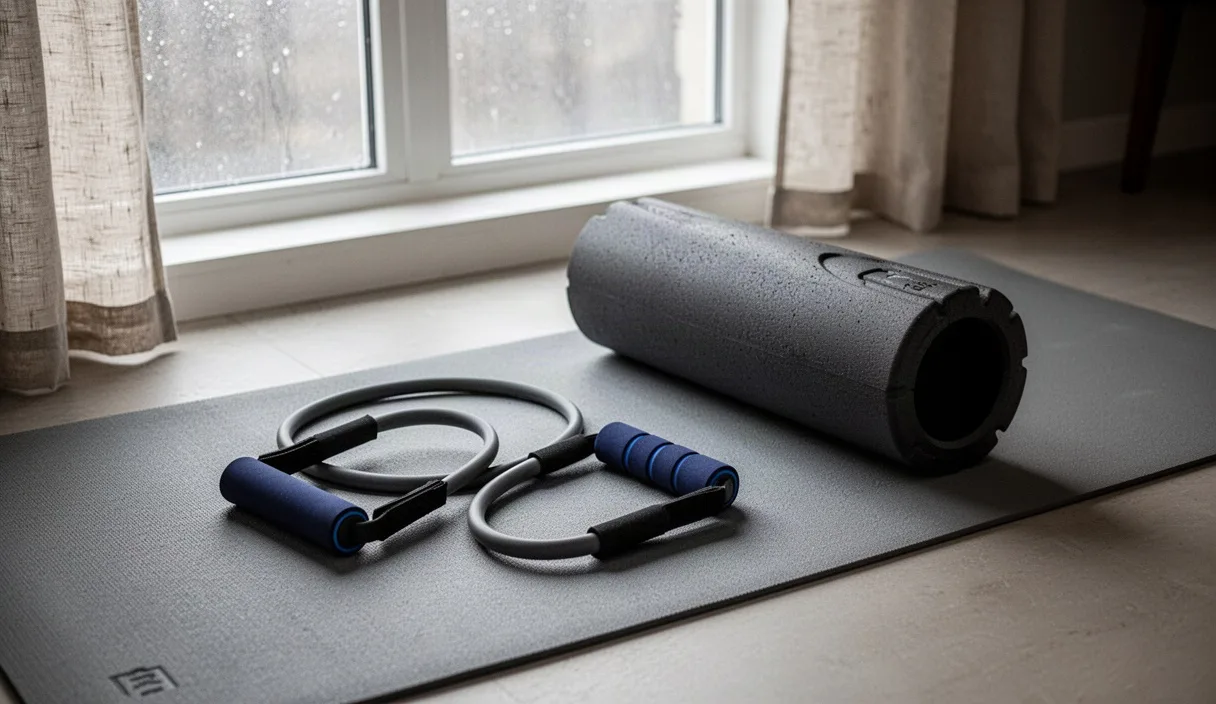
You don't need special equipment. A yoga mat helps if your floor is hard, but a carpeted bedroom works fine too. We'd suggest doing this before coffee, actually, since moving first thing tends to wake people up almost as effectively, and it means you're not stretching on a stomach that's about to get hit with caffeine.
Step-by-step sequence for the whole body
This sequence takes about 10 minutes if you move through it steadily, without rushing or lingering too long on any one stretch. Hold each static stretch for 20 to 30 seconds per side unless noted otherwise.
- Lying knee-to-chest (1 minute): While still on your back in bed or on a mat, pull one knee toward your chest, hold for 20 seconds, then switch legs. This gently opens the lower back and hips before you even stand up.
- Supine spinal twist (1 minute): Lying on your back, bring both knees to one side while keeping shoulders flat on the floor. Hold 20 to 30 seconds, then switch sides. This loosens the lower spine and obliques.
- Cat-cow on hands and knees (1 minute): Alternate arching your back up (cat) and dipping it down (cow) for about 8 to 10 slow repetitions. This is one of the most effective moves for spinal stiffness, since it moves the whole column through flexion and extension.
- Standing forward fold (1 minute): Stand up, feet hip-width apart, and slowly hinge forward, letting your knees bend as much as needed. Let your head hang heavy. This stretches the hamstrings and lower back without forcing anything.
- World's greatest stretch, one side then the other (2 minutes): Step one foot forward into a lunge, place both hands on the floor inside that foot, then rotate one arm up toward the ceiling while looking at your hand. This hits hips, hamstrings, and the upper back in one move. Spend about a minute per side.
- Standing quad stretch (1 minute): Hold onto a wall or chair for balance, pull one heel toward your glutes, hold 20 to 30 seconds, then switch. Useful if you sleep curled up with bent knees.
- Shoulder rolls and cross-body arm stretch (1 minute): Roll shoulders backward 10 times, then pull one arm across your chest, holding 15 to 20 seconds per side.
- Ankle circles and calf raises (1 minute): Standing or seated, rotate each ankle 10 times in both directions, then do 10 slow calf raises to wake up the lower legs.
- Three to five slow breaths (1 minute): Standing or sitting tall, breathe in for a count of four, out for a count of six. This closes the routine and settles your nervous system before the day starts.
That's the full 10 minutes. You can reorder these if something feels more useful on a particular day, say, doing the quad stretch longer after a run the night before.
How to adjust the routine if you're short on time
Some mornings you've got 10 minutes, some mornings you've got three. Here's a quick comparison of what to prioritize depending on how much time you actually have.
| Time available | What to keep | What to skip |
|---|---|---|
| 10 minutes (full routine) | Everything in the sequence above | Nothing, this is the complete version |
| 5 minutes | Cat-cow, forward fold, world's greatest stretch, one side each | Ankle circles, shoulder rolls, breathing block |
| 2 minutes | Cat-cow (30 seconds) and forward fold (30 seconds per side) | Everything else, save it for later in the day |
If mornings are consistently too rushed, another option is splitting the routine: do the spine and hip stretches right when you wake up, then catch the shoulder and ankle work during a mid-morning break at your desk or kitchen counter. Doing some stretching is better than doing none, even if it's broken into pieces.
Common mistakes that reduce the benefits
The biggest mistake we see is bouncing into stretches instead of moving slowly. Bouncy, jerky stretching, sometimes called ballistic stretching, can actually trigger your muscles to tighten up defensively rather than relax, especially first thing in the morning when tissues are cooler and less pliable.
Another common one is skipping the gentle warm-up movements and going straight into deep static holds. Jumping into a full forward fold cold, without a minute of cat-cow or knee-to-chest first, puts more strain on a hamstring or lower back that hasn't had any chance to wake up yet.
People also tend to hold their breath during stretches, which keeps muscles more tense than they need to be. Breathing slowly through each hold helps the stretch actually land. And lastly, rushing through all nine steps in under five minutes defeats the purpose a bit, since the benefit comes from giving each area at least 20 to 30 seconds, not from just technically touching every move.
When to skip or modify the routine
If you're dealing with an acute injury, a recent strain, sprain, or surgery, this is a good morning to skip stretching that area and check with a physical therapist or doctor about what's safe. Stretching through sharp or shooting pain is never a good sign, and that's different from the normal dull tightness of waking up.
For anyone with diagnosed conditions like cellular vitality, disc herniations, or hypermobility disorders, some of these moves, especially deep forward folds or spinal twists, may need modification. A physical therapist can usually suggest a version that's appropriate for your specific situation rather than a generic routine like this one.
On days when you're sick, exhausted, or just not feeling it, a shortened two-minute version is a reasonable compromise, or you can simply do a few slow breaths and some light ankle circles while still in bed. The goal isn't perfection every single day, it's building a habit that's flexible enough to stick around.
If you want to start tomorrow, keep it simple: do the full nine-step sequence once, note which stretch felt tightest, and give that one a little extra attention the next morning. Small, repeatable routines tend to outlast ambitious ones, and ten minutes a day adds up to a lot more mobility over a few months than the occasional heroic stretching session.